Scim: Intelligent Faceted Highlights for Interactive, Multi-Pass Skimming of Scientific Papers
@article{Fok2022ScimIF,
  title={Scim: Intelligent Faceted Highlights for Interactive, Multi-Pass Skimming of Scientific Papers},
  author={Raymond Fok and Andrew Head and Jonathan Bragg and Kyle Lo and Marti A. Hearst and Daniel S. Weld},
  journal={ArXiv},
  year={2022},
  volume={abs/2205.04561},
  url={https://api.semanticscholar.org/CorpusID:263892740}
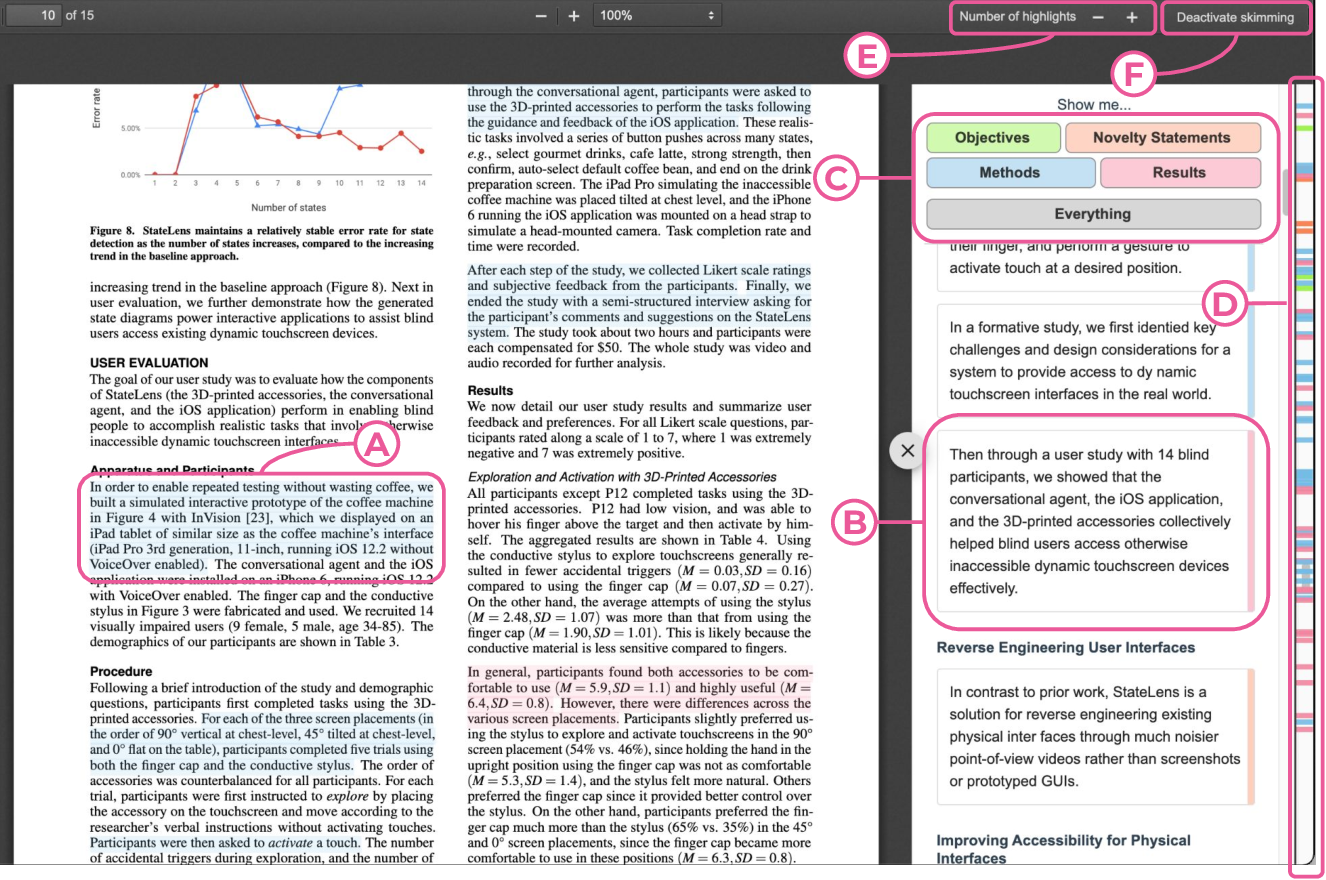
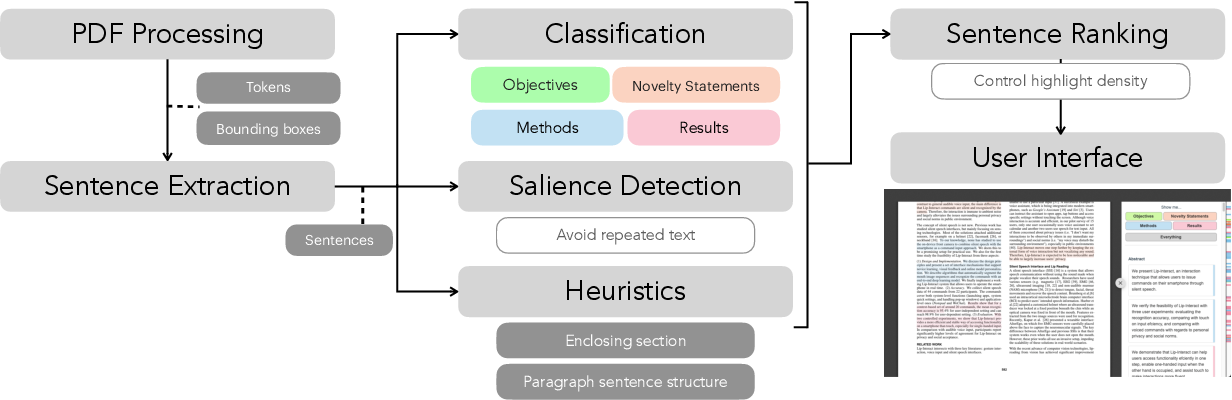
}Scim is presented, an AI-augmented reading interface designed to help researchers skim papers by automatically identifying, classifying, and highlighting salient sentences, organized into rhetorical facets rooted in common information needs.
8 Citations
Threddy: An Interactive System for Personalized Thread-based Exploration and Organization of Scientific Literature
- 2022
Computer Science
A tool integrated into users’ reading process that helps them with leveraging authors’ existing summarization of threads, typically in introduction or related work sections, in order to situate their own work’s contributions is developed.
Marvista: Exploring the Design of a Human-AI Collaborative News Reading Tool
- 2023
Computer Science
The design of Marvista is explored—a human-AI collaborative tool that employs a suite of natural language processing models to provide end-to-end support for reading online news articles to support the entire reading process.
Papeos: Augmenting Research Papers with Talk Videos
- 2023
Computer Science, Education
Papeos is presented, a novel reading and authoring interface that allow authors to augment their papers by segmenting and localizing talk videos alongside relevant paper passages with automatically generated suggestions.
CARE: Collaborative AI-Assisted Reading Environment
- 2023
Computer Science
This work proposes inline commentary as a natural vehicle for AI-based reading assistance, and presents CARE: the first open integrated platform for the study of inline commentary and reading, which facilitates the data collection and study ofinline commentary in NLP, extrinsic evaluation of NLP Assistance, and application prototyping.
Envisioning the Next-Gen Document Reader
- 2023
Computer Science
18 NLP-powered features to add to existing document readers and a novel plug-in marketplace that allows users to further customize their reading experience are described and proposed.
How Data Scientists Review the Scholarly Literature
- 2023
Computer Science
This paper examines the literature review practices of data scientists in an interdisciplinary field with evolving scholarly norms, uncovering several novel findings, and outlines future directions likely to help data scientists cope with the burgeoning research literature.
Charagraph: Interactive Generation of Charts for Realtime Annotation of Data-Rich Paragraphs
- 2023
Computer Science
Results of a study show participants can easily create Charagraphs for diverse examples of data-rich text, and when answering questions about data in text, participants were more correct compared to only reading text.
Cross-lingual extreme summarization of scholarly documents
- 2023
Computer Science, Linguistics
This paper explores how state-of-the-art neural abstract summarization models based on a multilingual encoder–decoder architecture can be used to enable cross-lingual extreme summaries of scholarly texts and investigates how to make the approach more efficient on the basis of knowledge distillation methods.
79 References
HiText: Text Reading with Dynamic Salience Marking
- 2017
Computer Science
HiText is presented, a simple yet effective way of dynamically marking parts of a document in accordance with their salience, which results in marked increases in user satisfaction and reading efficiency, as assessed using TOEFL-style reading comprehension tests.
Augmenting Scientific Papers with Just-in-Time, Position-Sensitive Definitions of Terms and Symbols
- 2021
Computer Science
This work introduces ScholarPhi, an augmented reading interface with four novel features: tooltips that surface position-sensitive definitions from elsewhere in a paper, a filter over the paper that “declutters” it to reveal how the term or symbol is used across the paper, automatic equation diagrams that expose multiple definitions in parallel, and an automatically generated glossary of important terms and symbols.
Wikum: Bridging Discussion Forums and Wikis Using Recursive Summarization
- 2017
Computer Science
This article describes a workflow called recursive summarization, implemented in the Wikum prototype, that enables a large population of readers or editors to work in small doses to refine out the main points of the discussion.
Scientific Information Understanding via Open Educational Resources (OER)
- 2015
Computer Science, Education
A novel learning/reading environment, OER-based Collaborative PDF Reader (OCPR), that incorporates innovative scaffolding methods that can auto-characterize student emerging information need while reading a paper and enable students to readily access open educational resources (OER) based on their information need is proposed.
Extracting references between text and charts via crowdsourcing
- 2014
Computer Science
A crowdsourcing pipeline is presented to extract the references between crowd workers paragraph-chart pairs and applies automated clustering and merging techniques to unify the references generated by multiple workers into a single set.
TLDR: Extreme Summarization of Scientific Documents
- 2020
Computer Science
This work introduces SCITLDR, a new multi-target dataset of 5.4K TLDRs over 3.2K papers, and proposes CATTS, a simple yet effective learning strategy for generatingTLDRs that exploits titles as an auxiliary training signal.
ScentHighlights: highlighting conceptually-related sentences during reading
- 2005
Computer Science
This work describes how it has enhanced skimming activity by conceptually highlighting sentences within electronic text that relate to search keywords by computing what conceptual keywords are related to each other via word co-occurrence and spreading activation.
Elastic Documents: Coupling Text and Tables through Contextual Visualizations for Enhanced Document Reading
- 2019
Computer Science
This paper parse the text content and data tables, cross-link the components using a keyword-based matching algorithm, and generate on-demand visualizations based on the reader's current focus within a document that couples text content with data tables contained in the document.
Articles Summarizing Scientific Articles: Experiments with Relevance and Rhetorical Status
- 2002
Computer Science, Linguistics
This article provides a gold standard for summaries of this kind consisting of a substantial corpus of conference articles in computational linguistics annotated with human judgments of the rhetorical status and relevance of each sentence in the articles.
The reader's helper: a personalized document reading environment
- 1999
Computer Science
A anew document reading environment is introduced called the Readers HelperTM, which supports the reading of electronic and paper documents and produces arelevance score for each of the readers topics of interest, thereby helping the reader decide whether the document is actually worthskimming or reading.