CiteRead: Integrating Localized Citation Contexts into Scientific Paper Reading
@article{Rachatasumrit2022CiteReadIL,
  title={CiteRead: Integrating Localized Citation Contexts into Scientific Paper Reading},
  author={Napol Rachatasumrit and Jonathan Bragg and Amy X. Zhang and Daniel S. Weld},
  journal={Proceedings of the 27th International Conference on Intelligent User Interfaces},
  year={2022},
  url={https://api.semanticscholar.org/CorpusID:247585131}
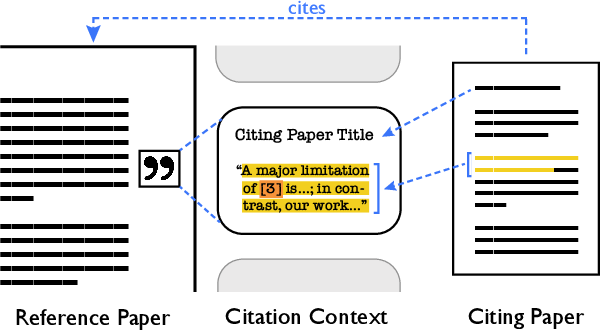
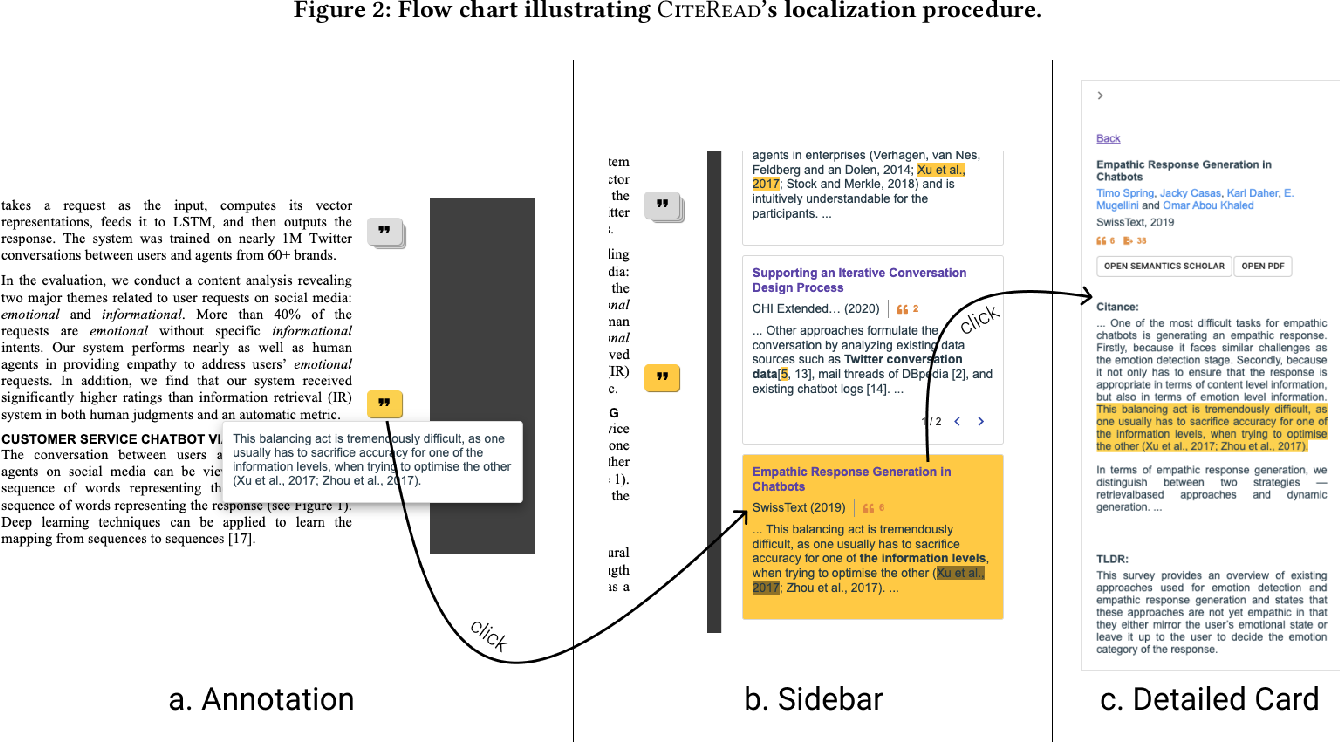
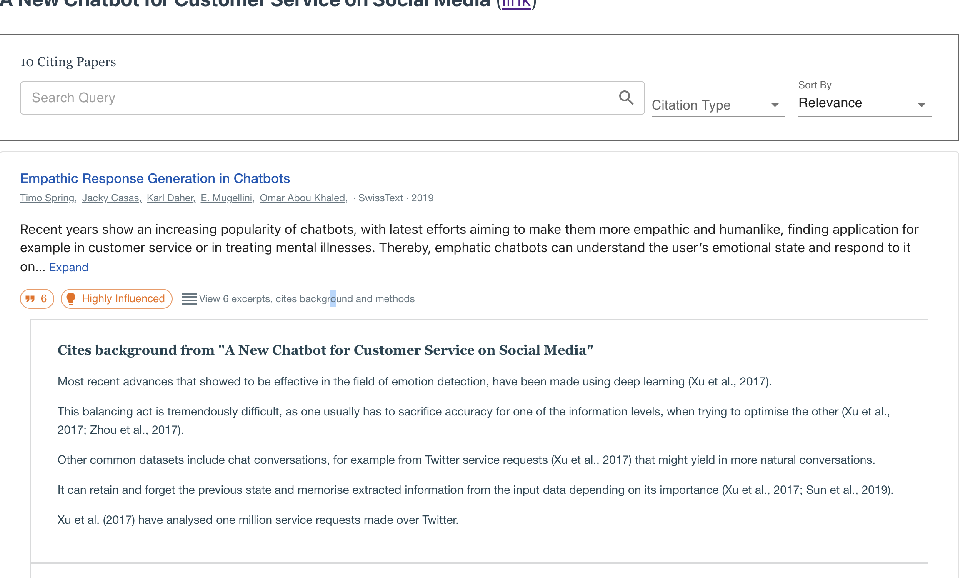
}A novel paper reading experience that integrates relevant information about follow-on work directly into a paper, allowing readers to learn about newer papers and see how a paper is discussed by its citing papers in the context of the reference paper.
38 Citations
CiteSee: Augmenting Citations in Scientific Papers with Persistent and Personalized Historical Context
- 2023
Computer Science
CiteSee is a paper reading tool that leverages a user’s publishing, reading, and saving activities to provide personalized visual augmentations and context around citations to help users prioritize their exploration.
CitePeek: Contextual Citation Exploration Within Research Papers
- 2025
Computer Science
CitePeek is presented, an interactive PDF assistant that transforms citations in a research paper into interactive elements that calculates contextual relevance through similarity scoring, presenting relevant paragraphs and relevance-based highlighting in original PDFs.
PaperWeaver: Enriching Topical Paper Alerts by Contextualizing Recommended Papers with User-collected Papers
- 2024
Computer Science
It was shown that participants using PaperWeaver were able to better understand the relevance of recommended papers and triage them more confidently when compared to a baseline that presented the related work sections from recommended papers.
The Semantic Reader Project
- 2024
Computer Science
The Semantic Reader Project is described, a collaborative effort across multiple institutions to explore automatic creation of dynamic reading interfaces for research papers, and a collection of novel reading interfaces are developed and evaluated and evaluated them with study participants and real-world users to show improved reading experiences for scholars.
Garden of Papers: Finding, Reading, and Organizing Research Papers in a Visual, Integrated, and Flexible Workspace
- 2025
Computer Science
Garden of Papers is presented, a novel sketch-based interactive system that allows users to perform research tasks quickly and easily on a 2D canvas, and quantitatively and qualitatively demonstrates that the system’s visual, integrated, and flexible workspace facilitates 9 usage patterns that enhance real-world literature reviews.
Citance-Contextualized Summarization of Scientific Papers
- 2023
Computer Science
This work proposes a new contextualized summarization approach that can generate an informative summary conditioned on a given sentence containing the citation of a reference (a so-called "citance") that outlines the content of the cited paper relevant to the citation location.
Threddy: An Interactive System for Personalized Thread-based Exploration and Organization of Scientific Literature
- 2022
Computer Science
A tool integrated into users’ reading process that helps them with leveraging authors’ existing summarization of threads, typically in introduction or related work sections, in order to situate their own work’s contributions is developed.
Qlarify: Recursively Expandable Abstracts for Dynamic Information Retrieval over Scientific Papers
- 2024
Computer Science
Recursively expandable abstracts are introduced, a novel interaction paradigm that dynamically expands abstracts by progressively incorporating additional information from the papers’ full text during their dive into the full text.
Beyond the Page: Enriching Academic Paper Reading with Social Media Discussions
- 2025
Education, Computer Science
Surf, a novel reading interface that enriches academic papers with Social Understanding of Research Findings, organizes social media clutter into digestible threads and presents them contextually within the paper, allowing readers to seamlessly access peer insights without disrupting their reading process.
CorpusStudio: Surfacing Emergent Patterns In A Corpus Of Prior Work While Writing
- 2025
Computer Science
This work proposes two new writing support concepts that reify document and sentence-level patterns in a given text corpus: an ordered distribution over section titles and given the user’s draft and cursor location, many retrieved contextually relevant sentences.
28 References
What Others Say About This Work? Scalable Extraction of Citation Contexts from Research Papers
- 2017
Computer Science
A prototype system which can retrieve, on-demand, citation contexts from the full text of over 15 million research articles in the Mendeley catalog for a given reference research paper is developed.
Augmenting Scientific Papers with Just-in-Time, Position-Sensitive Definitions of Terms and Symbols
- 2021
Computer Science
This work introduces ScholarPhi, an augmented reading interface with four novel features: tooltips that surface position-sensitive definitions from elsewhere in a paper, a filter over the paper that “declutters” it to reveal how the term or symbol is used across the paper, automatic equation diagrams that expose multiple definitions in parallel, and an automatically generated glossary of important terms and symbols.
Identifying Important Citations Using Contextual Information from Full Text
- 2017
Computer Science
This paper explores the effectiveness of eight previously published features and six novel features (including context based, cue words based and textual based) on an annotated dataset of 465 citations and achieves an overall classification accuracy of 0.91 AUC using the Random Forest classifier.
Identifying Meaningful Citations
- 2015
Computer Science
This work introduces the novel task of identifying important citations in scholarly literature, i.e., citations that indicate that the cited work is used or extended in the new effort, and proposes a supervised classification approach that addresses this task with a battery of features.
Do Peers See More in a Paper Than Its Authors?
- 2012
Computer Science, Medicine
Focusing on the area of molecular interactions, manual and automatic analysis is performed, and it is found that the set of all citances to a target article not only covers most information found in its abstract, but also contains 20% more concepts.
Structural Scaffolds for Citation Intent Classification in Scientific Publications
- 2019
Computer Science
This work proposes structural scaffolds, a multitask model to incorporate structural information of scientific papers into citations for effective classification of citation intents, which achieves a new state-of-the-art on an existing ACL anthology dataset with a 13.3% absolute increase in F1 score.
Contextualizing Citations for Scientific Summarization using Word Embeddings and Domain Knowledge
- 2017
Computer Science
An unsupervised model that uses distributed representation of words as well as domain knowledge to extract the appropriate context from the reference paper is proposed and demonstrated how an effective contextualization method results in improving citation-based summarization of the scientific articles.
Summarizing Key Concepts using Citation Sentences
- 2006
Biology, Computer Science
It is hypothesize that in many cases, as time goes by, the citation sentences can more accurately indicate the most important contributions of a paper than its original abstract.
Incidental or Influential? - Challenges in Automatically Detecting Citation Importance Using Publication Full Texts
- 2017
Computer Science
This work looks in depth at several studies that have attempted to automate the process of citation importance classification based on the publications’ full text and finds abstract similarity one of the most predictive features.
Elastic Documents: Coupling Text and Tables through Contextual Visualizations for Enhanced Document Reading
- 2019
Computer Science
This paper parse the text content and data tables, cross-link the components using a keyword-based matching algorithm, and generate on-demand visualizations based on the reader's current focus within a document that couples text content with data tables contained in the document.